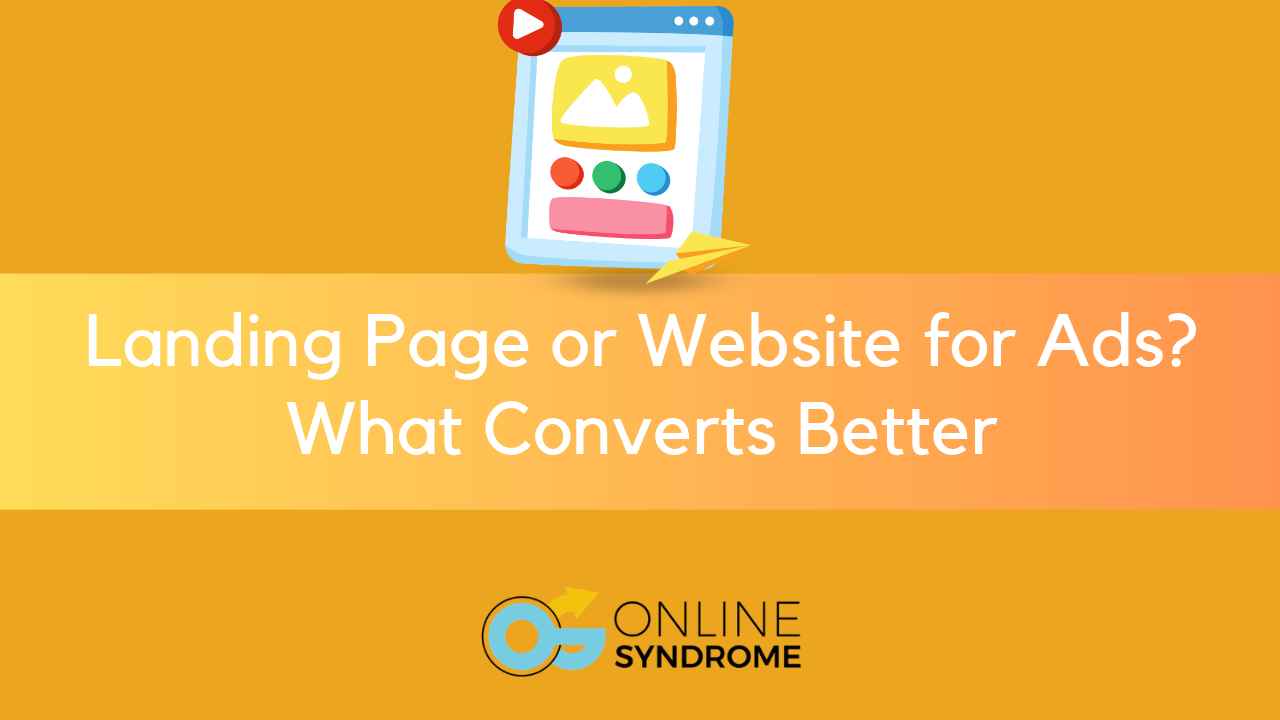
For most paid ads, a dedicated landing page converts better than your full website, because it has one offer, one message and one action, with no menu to lead visitors away. A website is the better destination for brand searches, awareness campaigns and retargeting. If you run ads to your homepage, you’re usually paying for distractions. You can book a consultation here.
Overview
Here’s a mistake we see constantly. A business spends real money on ads, picks a catchy headline and sends every click to the homepage. The homepage has a menu, an About section, a gallery, a blog, a team page and a contact form tucked at the bottom. A visitor who clicked because of one specific thing now has to hunt for it. Many of them don’t.
It isn’t that websites are bad. It’s that a homepage is built to introduce everything about you, while an ad promises one specific thing. When the two don’t line up, people leave, and you pay for the click anyway. This guide explains the difference between a landing page and a website, when each makes sense and how to build a page that earns its ad spend. OnlineSyndrome works on both sides, with website design and development and campaign management, so we see how much the page decides what the ads can do.
What Is the Difference Between a Landing Page and a Website?
In plain words
● Website: Many pages, many audiences, a menu, lots of choices
● Landing page: One page, one offer, one action, usually no menu
● A website explains who you are, while a landing page asks for one thing
● Ads work best when the page continues the ad’s promise
● Landing pages are easier to test and improve
A website helps people explore. A landing page helps people decide.
Meet the OnlineSyndrome Team
OnlineSyndrome describes itself as an agency that simplifies marketing for a complex world. Its services include SEO and search engine marketing, performance marketing, website design and development, social media management, lead generation and conversion, content creation, influencer marketing, and advertisement and content shoots. It works from offices in Azadpur and Dwarka, Delhi.
Professional Highlights
● Website design and development
● Performance marketing for search and social ads
● Lead generation and conversion support
● Offices in Azadpur and Dwarka, Delhi
Not sure where your ads are landing? Message us on WhatsApp with your ad and page link and we’ll tell you what we see.
Why Do Landing Pages Usually Convert Better?
LanderLab’s comparison of landing pages and websites lays out the core reasons clearly.
1. There Are Fewer Exits
A website menu gives visitors many ways to leave the page you want them on. A landing page removes most of those. The article cites VWO research suggesting that removing navigation can roughly double the conversion rate. Treat that as an indicator, not a promise, since results depend on your offer.
2. The Message Matches the Ad
If your ad says “Free home visit for AC service”, the page should open with that exact offer. A generic homepage breaks the promise, and trust drops quickly. This is called message match, and it is one of the biggest levers you have.
3. The Action Is Obvious
One headline, one short form or one call button, visible straight away. Visitors don’t have to think about what to do next.
4. It’s Easy to Test
Because the page has one job, you can change the headline, button or form and see what happens. On a full website, so many things overlap that it’s hard to learn anything.
Every extra choice on a page is a chance for the visitor to choose “leave”.
When Is Your Website the Better Destination?
Landing pages aren’t always the answer. The same LanderLab piece notes that a website makes more sense in some cases.
● Brand searches: People already know you and want to look around
● Awareness campaigns: There’s no single action to optimise for
● Retargeting: Warm visitors may want more detail, such as pricing or case studies
● Complex or high-value purchases: Buyers research, compare and read before deciding
● Hiring, PR or partnership traffic: Visitors want the whole story
If you’re not sure, test both. Send half the budget to each for a couple of weeks and compare enquiries, not clicks.
What Makes a Good Landing Page for Google Ads?
There’s no secret formula, but these basics show up on pages that work.
Core ingredients
● A headline that mirrors the ad. If someone searched it, they should see it.
● A clear offer. What do they get, and what happens next?
● A short form or a tappable call button. Ask only for what you need.
● Proof. Reviews, credentials, a client logo or a short testimonial.
● Speed. It should load fast on mobile data.
● A simple layout. Few distractions, easy to read on a phone.
● A thank-you step. A separate confirmation page also makes conversion tracking cleaner.
Our post on why you may not be getting enough leads shows how a weak page quietly drains a budget.
A Few Practical Notes
● Landing pages built only for ads are often set so search engines don’t index them, so they don’t attract visitors who never saw the ad. Ask your developer or agency to decide this deliberately.
● Don’t copy the whole homepage into a landing page. Strip it down.
● Keep one landing page per offer. A page that tries to sell three things sells none.
● Make sure the phone number works and someone answers it.
If your ads aren’t converting, it’s worth checking the page before changing the ads.
Why Choose OnlineSyndrome for Landing Pages and Ads?
Key advantages
● Design, development and campaign management under one roof
● Pages built around one offer and one action
● Tracking set up so you can see which page and ad produce enquiries
● Honest advice about when your website is enough
● Support with lead generation if you need more than clicks
See our lead generation and conversion work, or book your consultation here.
Signs Your Ads Are Landing on the Wrong Page
● Your ad goes to the homepage
● Visitors leave within seconds
● Your page headline doesn’t match the ad
● The form is long or hidden at the bottom
● The page is slow on a phone
● You can’t tell which ad brought which enquiry
● You’ve never tested a different page
How a Landing Page Gets Built
- Define the offer: One service or product, one audience, one goal.
- Write to match the ad: Headline, subheading and button copy follow the ad’s promise.
- Design for mobile first: Most clicks come from phones.
- Set up tracking: Calls, forms and WhatsApp clicks are recorded.
- Test and improve: Headlines, forms and buttons are tweaked based on results.
What Are the Benefits of the Right Page?
✔ More enquiries from the same ad spend
✔ Lower cost per lead
✔ Clearer data on what works
✔ Easier testing and improvement
✔ A better experience for people who clicked with intent
Habits That Keep Pages Performing
Simple habits that help
● Open your own ad and follow it on a phone
● Check that the headline matches what the ad promised
● Test the form and phone number every month
● Change one thing at a time
● Look at enquiries, not just visits
● Watch short explainers on YouTube if the terms feel unfamiliar
● Pair paid traffic with good follow-up, as explained in our post on whether to start with SEO or paid ads
A good ad earns the click. A good page earns the enquiry.
Why Do Delhi Businesses Trust OnlineSyndrome?
● A Delhi team that builds pages and runs the ads that feed them
● Plain explanations without jargon
● Practical tips on Instagram and LinkedIn
● Honest advice, even when your current page just needs small fixes
● Easy contact by phone, WhatsApp or email
Conclusion
For most paid ads, a focused landing page will outperform your general website, because it matches the ad’s promise and takes away the distractions. A website still has its place for brand searches, retargeting and bigger decisions. The simplest approach is to test: send ads to a clean landing page, compare enquiries and keep what works. If you’d like help building a page that earns its ad spend, OnlineSyndrome is happy to review what you have.
Contact OnlineSyndrome
Email: support@onlinesyndrome.com
Phone: +91 9555924602, +91 8920616669
Book your landing page consultation with OnlineSyndrome here
FAQs
Is a landing page better than a website for ads?
For most paid ads, yes. A landing page has one offer and no distractions, so it usually converts better than a general website.
Should I send Google Ads to my homepage?
Usually no. A homepage serves many goals, while an ad makes one promise, and the mismatch loses visitors.
When should I use my website instead of a landing page?
For brand searches, awareness campaigns, retargeting and complex purchases where people want to research.
What makes a good landing page for Google Ads?
A headline that matches the ad, a clear offer, a short form or call button, proof, fast loading and a simple mobile layout.
How do I know if my landing page is working?
Track enquiries, not just clicks, and compare the page against alternatives over a couple of weeks.